
Marketing RWAs: who is actually buying tokenised assets?
Who is actually buying tokenised assets today? New research shows that RWA demand is driven by crypto-native institutions, not traditional finance. Here's what the data reveals—and what every RWA issuer should change in their marketing, distribution, and founder strategy.
71,697 buyers. $91.3 billion in gross onchain acquisitions. Ten tokenised dollar-yield products.
The numbers are large, but the most interesting finding from Arrakis Finance’s latest analysis is not the size of the market. It is the identity of the people behind the wallets.
The research used Ethena’s sUSDe as a benchmark and traced buying activity across a selection of tokenised real-world asset products. Its main conclusion challenges one of the most common RWA narratives: institutional-sized capital is already moving onchain, but most of it is still coming from crypto-native institutions.
This distinction matters for RWA marketing.
Most issuers are not selling to a mass retail audience, and they are not waiting for pension funds to start managing their existing portfolios directly through public blockchains. Their immediate buyers are protocol treasuries, DAOs, crypto funds, exchanges, market makers and specialised allocators deploying millions through purpose-built wallets.
So, RWA marketing needs to help a relatively small group of sophisticated buyers discover the product, understand the structure, evaluate the risks and defend the allocation internally.
The buyer is institutional-sized, but still crypto-native
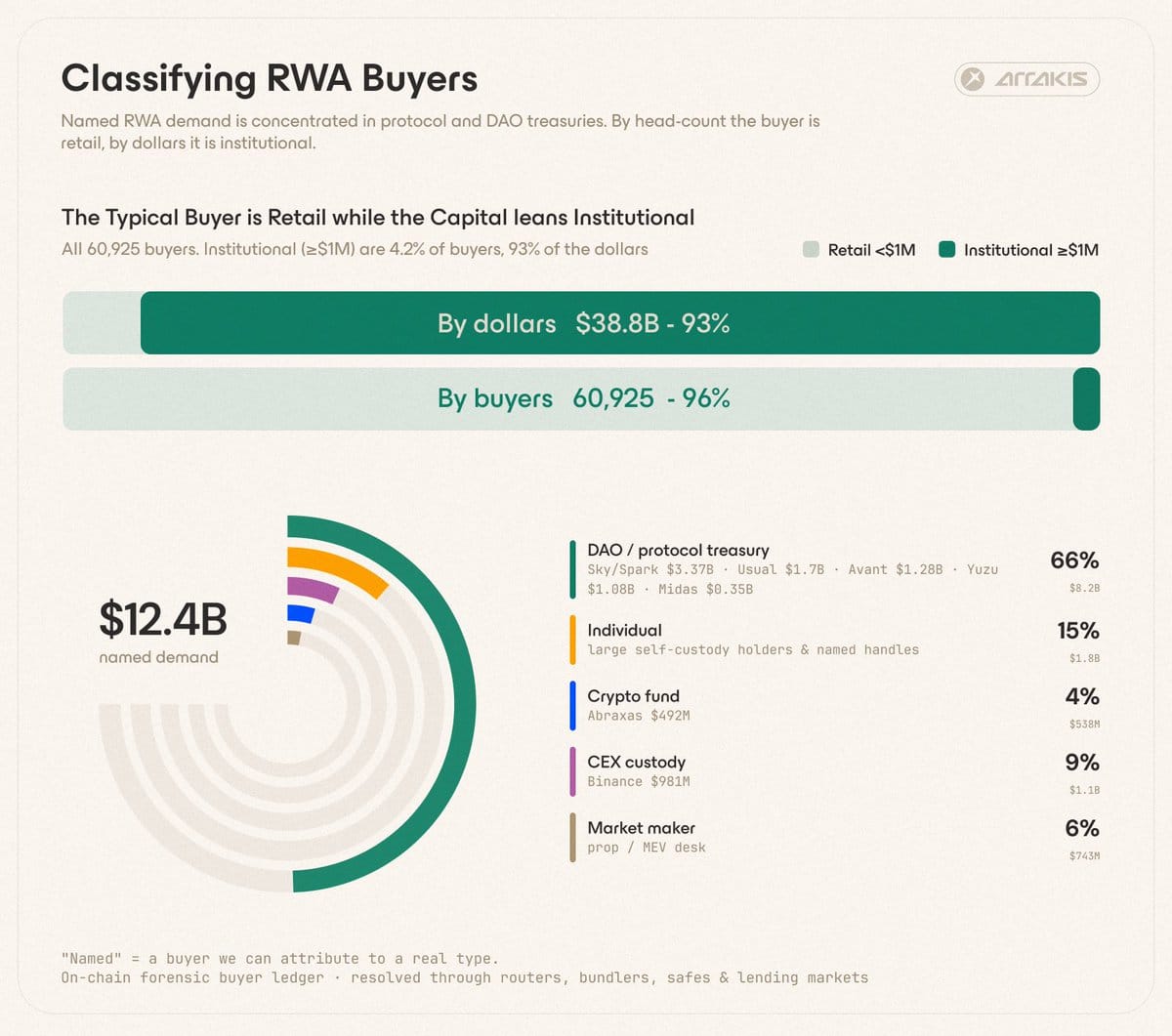
Arrakis was able to attribute approximately $12.4 billion of demand to identifiable buyer categories. Around two-thirds of this capital came from protocol and DAO treasuries. The rest was divided between individuals, exchanges, market makers and crypto funds.
The researchers did not find a single allocation that could clearly be traced to a traditional pension fund, bank, asset manager or similar TradFi institution.
This does not mean institutions are absent. It means we need to be more precise about what institutional adoption currently looks like.
The study classified wallets holding or acquiring at least $1 million as institutional buyers. These wallets represented only around 4% of all buyers, but they controlled approximately 93% of the acquired capital.
The market read is simple: RWAs are currently being bought by institutions that already operate onchain.
This group includes crypto foundations, protocol treasuries, family offices, exchanges, market makers and specialist funds that already understand wallets, stablecoins, custody and smart-contract risk.
Retail activity can still look impressive when measured by wallet count. It becomes much less impressive when measured by capital.
Ondo’s USDY, for example, was approximately 95.6% retail by buyer count in the Arrakis sample. Yet retail wallets held less than 1% of the acquired value. Ethena’s sUSDe had the strongest retail presence, but institutional-sized buyers still represented the majority of acquired capital.
For marketers, this is an important warning.
Wallet count, social reach and community size can create a distorted picture of demand. A product may attract thousands of small holders while remaining dependent on fewer than ten major allocators.
Want to get more research and case studies like this directly into your inbox?
Don't hesitate to subscribe. It's absolutely free.
A few large allocations can shape the whole market
The concentration of RWA capital changes how issuers should define their ideal customer profile.
An RWA project may still need broad category awareness, but its revenue and TVL will often depend on a narrow list of target accounts:
- Stablecoin and protocol treasuries
- DAO asset-allocation teams
- Crypto-native family offices
- Centralised exchanges
- Market makers
- DeFi credit curators
- Onchain asset managers
- Fintech and wealth platforms looking for yield products
Cheque sizes also vary significantly between product categories.
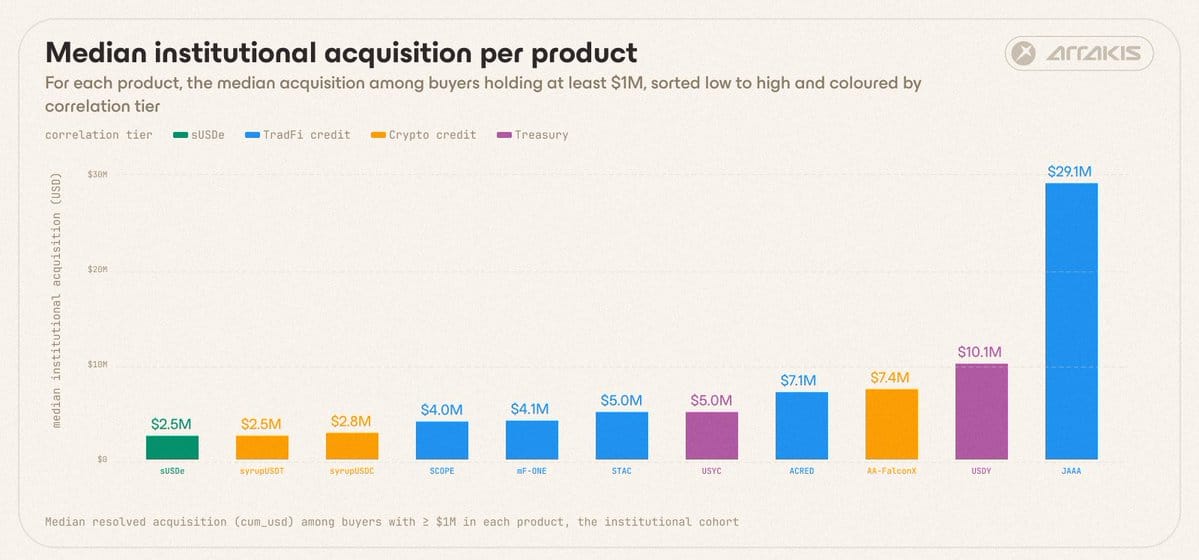
Arrakis found that products resembling traditional private-credit or Treasury allocations attracted the largest institutional commitments. Centrifuge’s JAAA had a median institutional acquisition of approximately $29.1 million – nearly three times the next-largest product in the sample.
These buyers are looking at custody, legal structures, redemption terms, underlying assets, counterparty exposure, reporting, collateral utility and secondary liquidity. Depending on the organisation, several teams may need to approve the same allocation.
A brand campaign can create the first signal, but the issuer still has to turn that initial awareness into confidence.
Most RWA purchases happen through primary subscription
Between 93% and 100% of acquisitions for the RWA products in the Arrakis sample originated through primary subscription. Genuine DEX entry represented between 0% and 6% for most assets.
Ethena’s sUSDe was the major exception, with approximately 55% of acquisitions taking place through decentralised exchanges.
This makes the typical RWA acquisition funnel very different from a liquid-token funnel.
For most issuers, marketing is not sending users directly towards a DEX swap. It is sending potential buyers into a gated subscription process that may include eligibility checks, documentation, KYC, wallet whitelisting and communication with the issuer or its distribution partners.
The funnel looks closer to institutional B2B sales:
Category awareness → product research → internal evaluation → compliance and risk review → subscription → ongoing reporting
This is also why RWA marketing cannot depend entirely on incentives, token announcements or performance content.
The buyer needs materials that can survive scrutiny after the person who first discovered the product forwards it to legal, risk or an investment committee.
RWA issuers are marketing to hidden buyers
The wallet is only the visible endpoint of a much larger decision process.
Inside a fund, exchange, DAO or treasury, the final decision may involve investment leads, risk analysts, legal counsel, compliance specialists, finance teams, operations managers and governance participants.
Many of these people will never speak directly with the issuer’s sales team.
The Edelman–LinkedIn 2025 B2B Thought Leadership Impact Report describes these stakeholders as hidden buyers: people who can influence or block a purchasing decision while remaining largely invisible to the vendor.
According to the report, 63% of hidden decision-makers spend more than one hour per week consuming thought leadership – almost the same percentage as target buyers. Around 55% use thought leadership while evaluating potential vendors.
At the same time, 71% said they had relatively little or no interaction with sales representatives.
Good research also helps internal supporters build consensus. Fifty-one per cent of hidden decision-influencers said thought leadership helped them convince C-level executives, while 52% said it helped them persuade other people involved in the evaluation process.
For an RWA issuer, this makes research and public expertise part of the sales infrastructure.
A strong report can reach the risk manager whom the business development team does not know. A founder interview can help an internal champion explain the market thesis. A transparent dashboard can give a compliance team or investment committee the evidence it needs to move forward.
What leading RWA companies are doing differently
The strongest RWA brands are creating systems around their products: original research, institutional validation, education, public leadership and direct access to potential allocators.
Centrifuge: owning the tokenisation category
Centrifuge has developed one of the clearest category-building strategies in the RWA market.
Its Tokenization Outlook 2026 surveyed 150 operators across issuers, infrastructure providers, DeFi protocols, exchanges, market makers and data platforms.
The report found that 86% believed scaling distribution was more important than launching additional tokenised products. Regulation and liquidity accounted for 76% of the industry’s reported bottleneck concerns.
This gives Centrifuge a credible reason to participate in discussions beyond its own platform. Instead of publishing another general explanation of what it offers, the company produces data that asset managers, infrastructure teams, investors and journalists can use.
Centrifuge reinforces that research through the Real-World Asset Summit, an international event series connecting capital-markets and crypto participants.
It has also produced the Tokenization, Unwrapped documentary and previously launched the Fixing Finance campaign, which combined an interactive microsite, video, industry report and quiz to make the TradFi–DeFi relationship easier to understand.
The strategy has several connected layers:
- Research builds intellectual authority.
- Events provide direct access to allocators and partners.
- Creative campaigns improve category recognition.
- Product partnerships turn the narrative into distribution.
Centrifuge’s 2026 collaboration with Coinbase illustrates the final layer. Coinbase designated Centrifuge as a preferred tokenisation infrastructure platform, while the two companies positioned distribution, utility and trust as the next requirements for RWA growth.
Ondo: combining institutional positioning with broad awareness
Ondo has consistently positioned itself around the idea of institutional-grade finance, delivered onchain.
That message is supported by its products, policy participation, ecosystem partnerships and flagship events.
The Ondo Summit has become a central part of its category presence, bringing together executives, investors, policymakers and infrastructure providers to discuss tokenisation, regulation and financial-market structure.
The 2026 edition positioned itself as a major summit for real-world asset tokenisation rather than a product-specific community event. That difference matters. It allows Ondo to sit at the centre of the category conversation instead of only talking about its own product suite.
Ondo also uses policy commentary as a form of institutional thought leadership. Its public letter to the US Securities and Exchange Commission presented a practical roadmap for tokenised securities, giving the company a role in shaping the conversation around market rules.
Partnership announcements reinforce the same positioning.
A 2026 pilot involving Ondo, Kinexys by J.P. Morgan, Mastercard and Ripple demonstrated a framework for near-real-time cross-border settlement and tokenised-asset redemption.
The event, policy and partnership layers all support one consistent message: Ondo wants to be seen as infrastructure for a new capital-market system.
Maple: turning transparency into a marketing asset
Credit products depend heavily on trust in underwriting, collateral and risk management.
Maple has responded by making transparency a visible part of its market presence.
In May 2026, Maple announced independent proof of reserves for syrupUSDC and syrupUSDT in collaboration with The Network Firm. The reports are designed to confirm whether the loan book is fully collateralised, calculate the value of the collateral and verify that assets are held with approved custodians.
This is operational infrastructure, but it is also useful marketing content.
It gives existing and prospective allocators a clear, shareable answer to one of the first diligence questions they are likely to ask.
Maple supports this transparency layer with regular market updates, performance reviews, product explainers and data-led recaps. Its 2025 review reported more than $11.27 billion in loan originations across 60 unique borrowers.
Founder visibility is also built into the strategy.
Many of Maple’s research and product articles are attributed to CEO and co-founder Sidney Powell, whom the company explicitly describes as its public voice on onchain asset management, yield and institutional lending.
The founder persona becomes part of the trust layer surrounding the product.
Securitize: building credibility through institutional proof
Securitize relies heavily on institutional validation.
The strongest example is the BlackRock USD Institutional Digital Liquidity Fund, or BUIDL – the first tokenised fund issued on a public blockchain by the world’s largest asset manager.
The company has also highlighted infrastructure relationships with established financial-market organisations, including its selection as an NYSE tokenisation partner and its role as Computershare’s official tokenisation agent.
Potential clients can look at the institutions already willing to work with the platform.
Securitize supports this institutional proof with an educational content library covering tokenisation, digital securities and the potential benefits for asset managers, advisors and long-term investors.
Three priorities for RWA marketing
The examples above point to three foundational activities that RWA issuers should prioritise.
1. Publish institutional research
Institutional research gives an RWA company permission to enter conversations that would otherwise be dominated by established asset managers, consultants and data providers.
The best research does not repeat the expected growth of tokenisation for the hundredth time. It answers the questions allocators are already asking:
- Who is buying each asset class?
- What are the typical allocation sizes?
- Where does the capital originate?
- How long do buyers retain their positions?
- Which products are being used as collateral?
- How deep is secondary liquidity?
- What happens during periods of market stress?
- How do realised returns compare with advertised yields?
- Which legal, custody and redemption structures are gaining adoption?
Arrakis’ analysis is useful because it replaces assumptions about institutional adoption with wallet-level evidence.
Centrifuge’s outlook works because it brings together the views of operators from across the market.
Maple’s proof-of-reserves programme addresses a specific buyer-risk question directly.
RWA research should function as a diligence asset. An internal champion should be able to forward it to the CIO, legal team or risk committee without having to rewrite the argument first.
2. Build category awareness, not only product awareness
The concentration of RWA buyers changes the kind of awareness that matters.
A narrow buyer base still needs repeated exposure before an issuer feels credible.
Hidden buyers may encounter the company through an industry report, founder interview, event panel, partner announcement, policy document or specialist researcher long before they enter a formal sales process.
Useful awareness activity can include:
- Institutional research launches
- Data-led editorial series
- Industry summits and private allocator events
- Documentaries and educational video formats
- Partner campaigns with custodians, stablecoin issuers and DeFi protocols
- Policy and regulatory commentary
- Case studies showing real allocation behaviour
- Collaborations with trusted institutional and crypto-native researchers
The geographic findings from Arrakis also deserve attention.
Approximately 42% of significant buyers operated primarily during EMEA hours and 40% during APAC hours. The Americas represented only 18%.
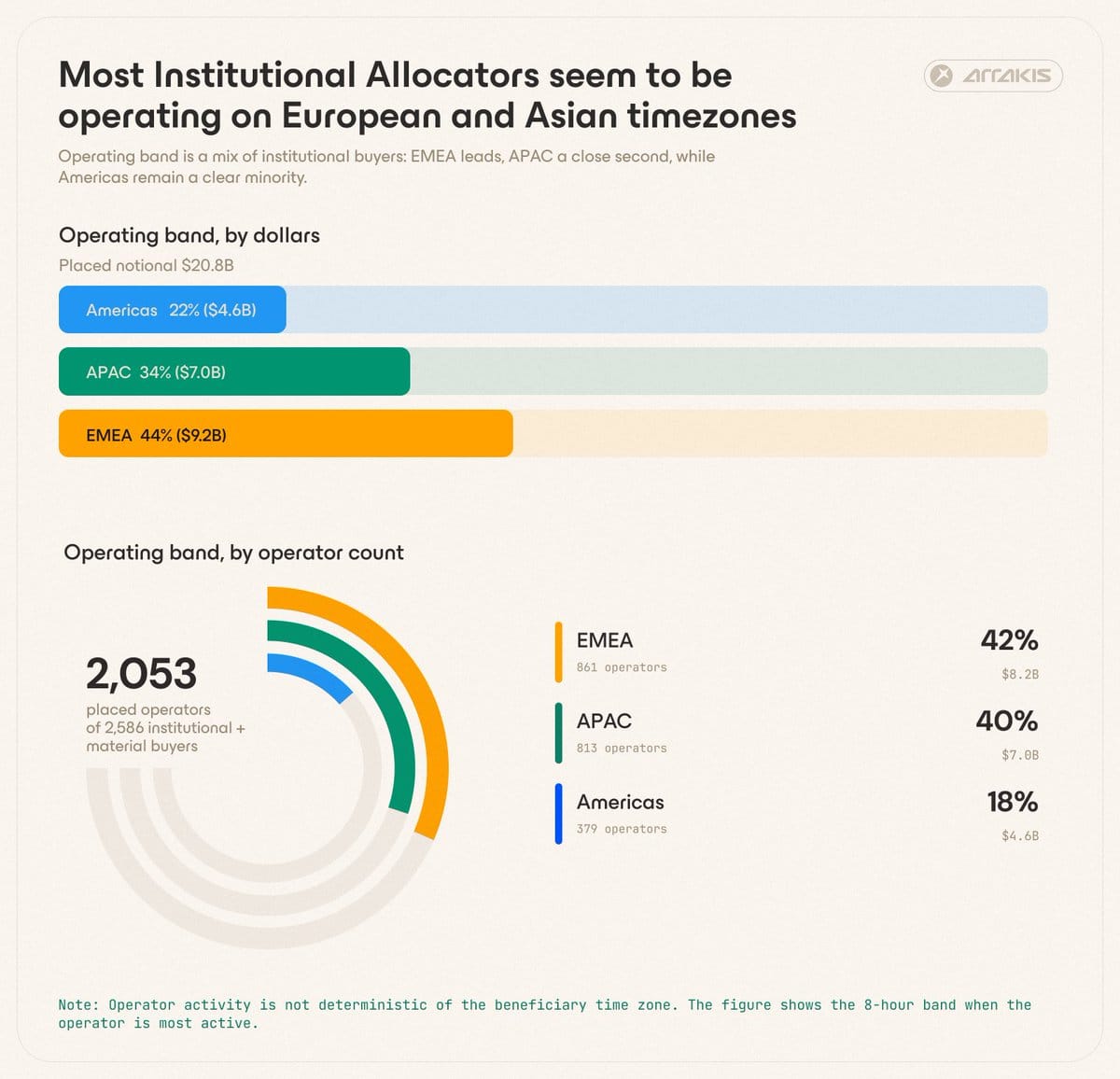
For many issuers, international distribution, regional media relationships and coverage during European and Asian working hours may produce more relevant reach than a communications strategy focused almost entirely on the US.
3. Treat the founder persona as pre-sales infrastructure
RWA products are complex, regulated and difficult to differentiate through surface-level messaging.
A visible founder or senior executive gives the market a clearer way to understand how the company thinks.
Useful founder content can explain:
- The company’s view of tokenisation and market structure
- How the underlying product is designed
- Which risks the team considers material
- How underwriting or asset selection works
- The company’s position on regulation and investor protection
- What the team learned from market stress or product performance
- Where current industry narratives may be wrong
The strongest founder content provides interpretation that a corporate account cannot deliver as naturally. It shows judgement, priorities and how the team responds when conditions become less comfortable.
The hidden-buyer data helps explain why this matters. Many internal stakeholders consume thought leadership while having little contact with sales. A credible founder can reach these people before the company even knows that an allocation is being discussed.
A practical RWA marketing funnel
An RWA issuer can organise its marketing around four stages.
Awareness
Research, founder commentary, events, partner campaigns and specialist media introduce the company and its market thesis.
Validation
Ratings, audits, attestations, legal documentation, performance reports, case studies and transparent dashboards help potential buyers evaluate the product.
Allocation
Clear subscription documents, responsive institutional coverage, custody support and white-glove onboarding turn interest into capital.
Retention
Ongoing reporting, product updates, market commentary, liquidity development and DeFi integrations give buyers reasons to maintain or increase their allocation.
Final thoughts
The current RWA market is being driven by a relatively small number of institutional-sized, crypto-native allocators.
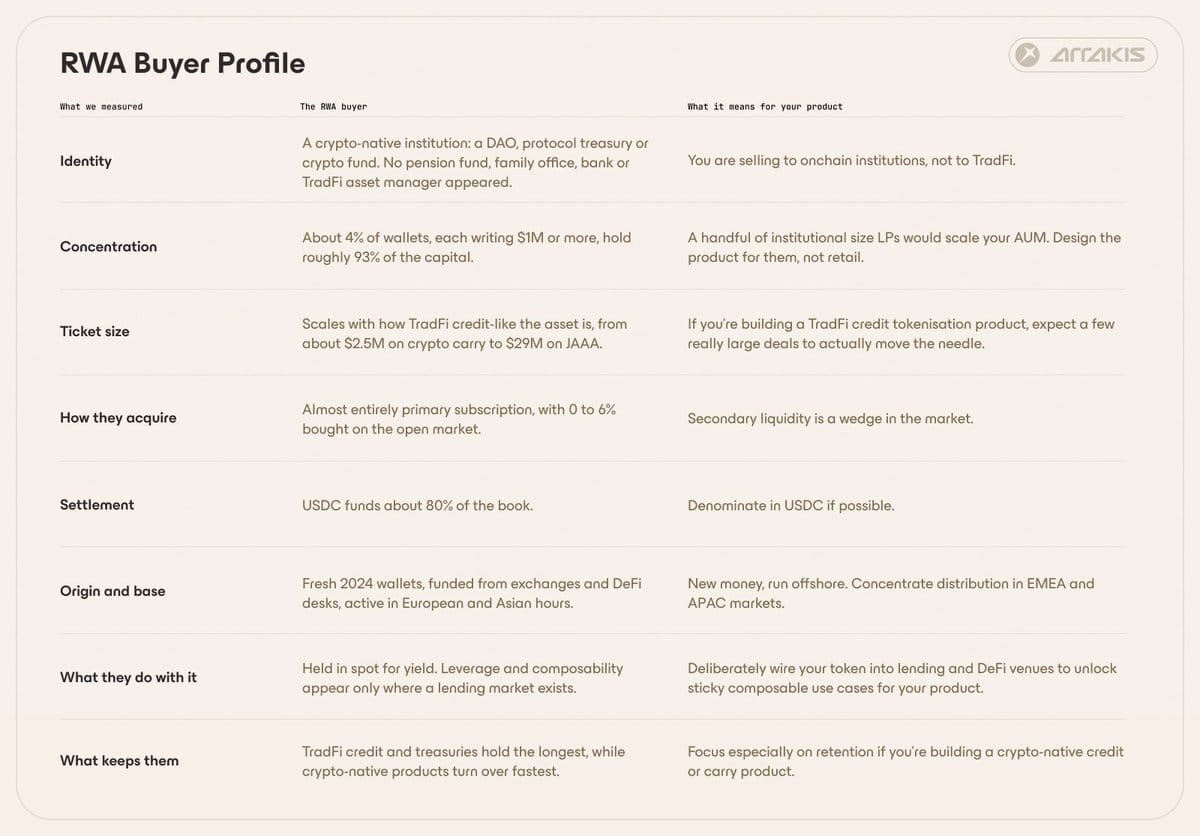
These buyers are already onchain. They tend to subscribe directly, deploy USDC, use relatively new wallets and operate primarily during European and Asian hours.
A handful of large accounts can determine whether an RWA product reaches meaningful scale.
This creates a marketing model built around evidence, trust and institutional relevance.
Subscribe to get new field notes when they go live.
Author note
Written by Stacy Muur, founder of Green Dots. Green Dots works with Web3 teams on GTM strategy, creator-led distribution, founder growth, and launch architecture.