
Telegram Ads: Growth experiment that revealed a money farming machine
This case study dives into Green Dots’ latest experiment on Telegram ad efficiency, raising concerns about the quality of acquired traffic
TL;DR: Telegram Ads told me I got almost 200 new subscribers. My channel grew by 30. This is what I found when I went looking for the other 170.
It’s not just crypto where people are extracting the maximum possible value from every activity.
The ad market is another massive money-farming machine – especially when creators start earning from ads and the platform allows deep targeting.
This is a case study of my latest experiment with Telegram ads, which revealed a pattern marketers haven’t discussed before.
Backstory
In late August, I started building GTM in public with the ambition to turn it into the largest community of marketers and founders.
Since one of the channel’s main goals is to share real experiments, I run continuous public tests to attract new people to the community – and that’s how I started running Telegram Ads.
My first step was to identify the most efficient target clusters.
That’s why I created the first batch of seven ad creatives (dated 1–2 September), each set at 5 TON CPM and a 30 TON initial budget.
The plan was to find the best-performing clusters first, then start experimenting with creatives to identify the winning tactic. After that, I’d follow the “One creative, one community” approach, which would let me optimize for maximum ad efficiency.
Provide a caption (optional)If you take a closer look at the stats here, it already starts smelling like shit.
- Broad targeting | Basic = 3.7% follow CR
- MKT channels | Basic = 1% follow CR
- MKT businesses | Basic = 1.6% follow CR
- CTR (click rate) 14.42% for Broad targeting vs. 4.37% for handpicked channels.
Meanwhile, others are heavily underperforming.This can create a false feeling of, “Oh, I just found the best-performing targeting groups,” but the reality is much uglier.
Part 1: What's happening when you apply broad targeting
First, let me clarify two important things in the context of Telegram Ads:
- Telegram Ads follows a CPM model, meaning you pay per 1,000 impressions. It’s auction-based, so the ad with the highest CPM gets shown to users. You can set it as low as 0.1 TON, but the realistic range (based on my experiments) is 2–8 TON CPM, depending on the topic.
- Channel owners receive 50% of the revenue generated from the sponsored messages displayed in their public feeds.
And this is where the farming wheel starts running.
There are two targeting options on Telegram: you can either choose specific channels or target a topic. The latter is the setup behind the “best performing” Broad targeting | Basic setup.
Provide a caption (optional)I realized something was wrong when Telegram Ads stats showed almost 200 new followers – yet the follower counter in my community barely grew by 30.
That’s why I started digging into what was happening – and that’s how the farming engine was revealed.
Provide a caption (optional)See this spike in the number of followers lost on September 2? It’s the result of the Broad targeting | Basic ad.
Here’s my hypothesis about what was happening:
- In broad targeting, Telegram likely optimises for the best-performing channel based on its internal analytics. Better results = higher ad spend = more revenue for Telegram.
- Channel owners monitor when their channel is chosen for targeting – and then activate a bot farm.
- In the “recent actions” history, I saw a long list of accounts joining the channel and leaving again within a few minutes.
This one was easy to spot, so I stopped this type of ad the same day. I cross-checked the results on September 3 with a lower CPM, and when the same story repeated, I decided to stop this ad entirely.
So... In my test, 86% of the subscribers acquired through broad targeting left within hours. The ad platform counted every one of them as a conversion I paid for.
This made me more sceptical of the data from Telegram Ads, and I started second-guessing all the results.
Part 2: Targeting specific channels does not save you from bots either
While tracking “recent actions,” I spotted several accounts with similar-looking, ugly names that were online DAYS and MONTHS before I even started running these creatives.
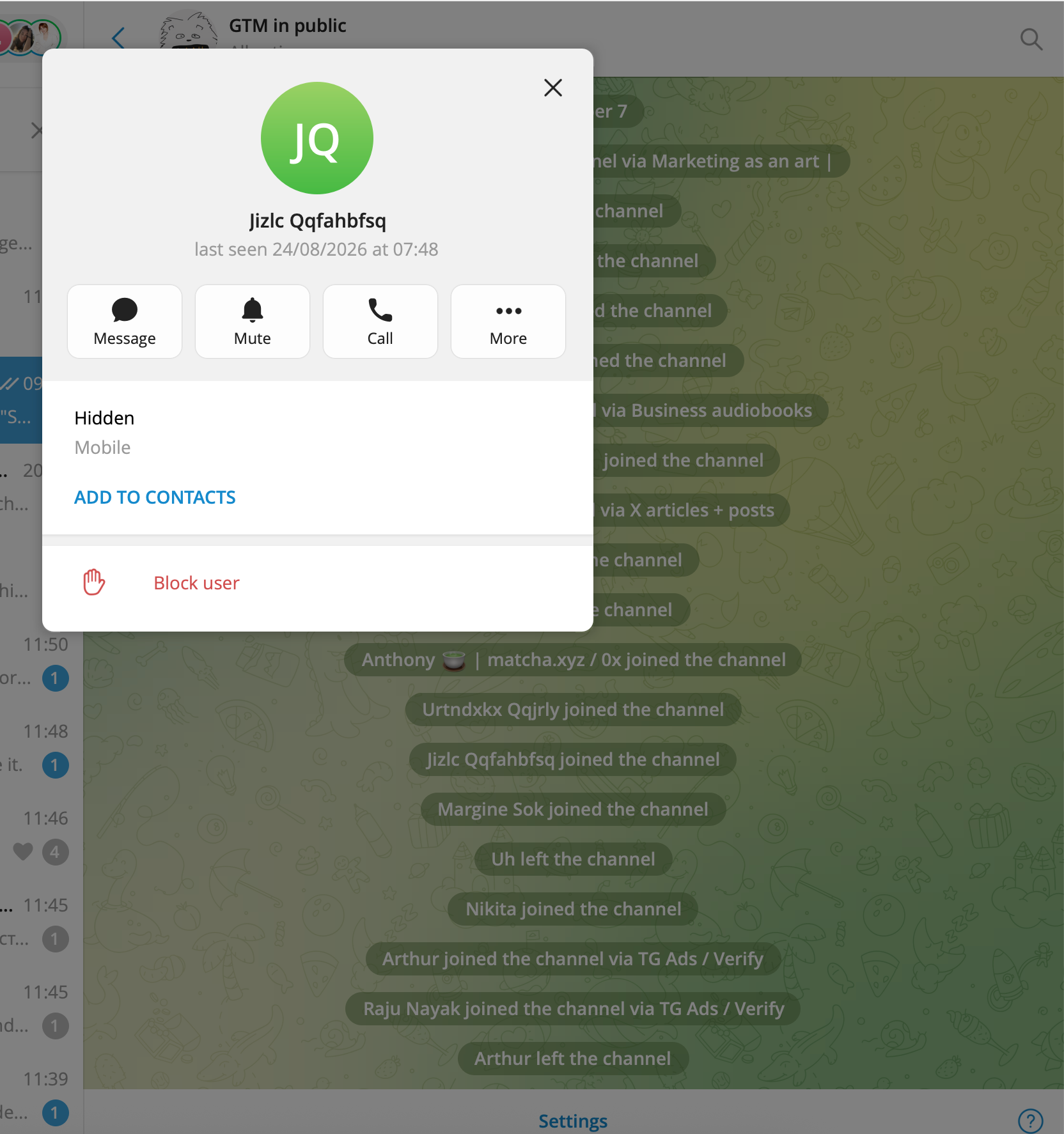
Telegram's "last seen" reflects presence, not activity. You cannot join a channel without opening the app, and opening the app makes you online.
For a human, "joined in September" and "last seen in July" are mutually exclusive. For an account driven through Telegram's API they are not: online status is a separate call, and a headless client simply never sends it. What I was looking at was action without presence.
Initially, I wasn’t expecting to have to verify Telegram ads results. So new joins from these sources didn’t have a unique link, and I wasn’t able to identify which channel group they came from.I did know they were coming from one of the targeted groups – most likely MKT Channels | Basic.
Provide a caption (optional)Same pattern as before: someone was running bot traffic to make the ad look better than it is, so the advertiser spends more, and the channel owner also makes more money from this.
So yeah – this is the ugly reality: Telegram ads have bot farms, and you have to be very critical when you run them.
So what do you do as an advertiser?
- Compare the platform's action count with your channel's actual net growth over 48h.
- Open Followers → Joined/Left. A spike in Left on the day of delivery is your answer.
- Check "last seen" on recent joiners against their join date.
- Watch CTR. Above ~7% is not a good creative, it's a warning.
- Use a separate invite link per ad. I didn't, and it cost me this article's certainty.
If this article was insightful, make sure to join GTM in public by clicking the button below
Much love,
Stacy