
Web3 User Acquisition: Why CAC Expectations Are Broken
The Green Dots 2025–2026 Web3 Marketing Study shows a structural gap in crypto user acquisition: teams want fintech-level growth with CAC expectations that often sit below $30.

Most Web3 teams are still planning user acquisition around numbers that no longer match the market.
In early 2026, Green Dots surveyed 150+ crypto companies to understand how teams approach growth: CAC expectations, channel mix, marketing budgets, KOL campaigns, founder visibility, and AI search.
The data shows a clear gap between what teams want acquisition to cost and what durable acquisition usually requires.
That expectation shapes everything else: budgets, channel choice, creator selection, measurement, and how teams judge whether a campaign “worked.”
The problem is not only that Web3 CAC is hard to measure. The larger problem is that many teams are still using acquisition assumptions from earlier crypto cycles, when airdrops, speculative demand, and organic incentives made growth look cheaper than it really was.
What is CAC in Web3?
CAC, or customer acquisition cost, measures how much a team spends to acquire one user or customer.
In Web3, CAC is harder to track than in many traditional markets because users move across wallets, exchanges, communities, social accounts, and on-chain actions. A person may first see a project through a KOL post, join Telegram, interact with a testnet, connect a wallet weeks later, and eventually use the product through a different address.
That makes perfect attribution difficult.
But difficult tracking is not the same as impossible tracking. Teams can still build directional CAC models using campaign spend, referral links, wallet cohorts, campaign timing, activation data, on-chain behavior, and retention proxies.
Without that, acquisition decisions become guesswork.
The Web3 CAC gap is bigger than most teams admit
The Green Dots study found that nearly 60% of Web3 teams surveyed targeted CAC below $30. More than one-third targeted CAC below $15.
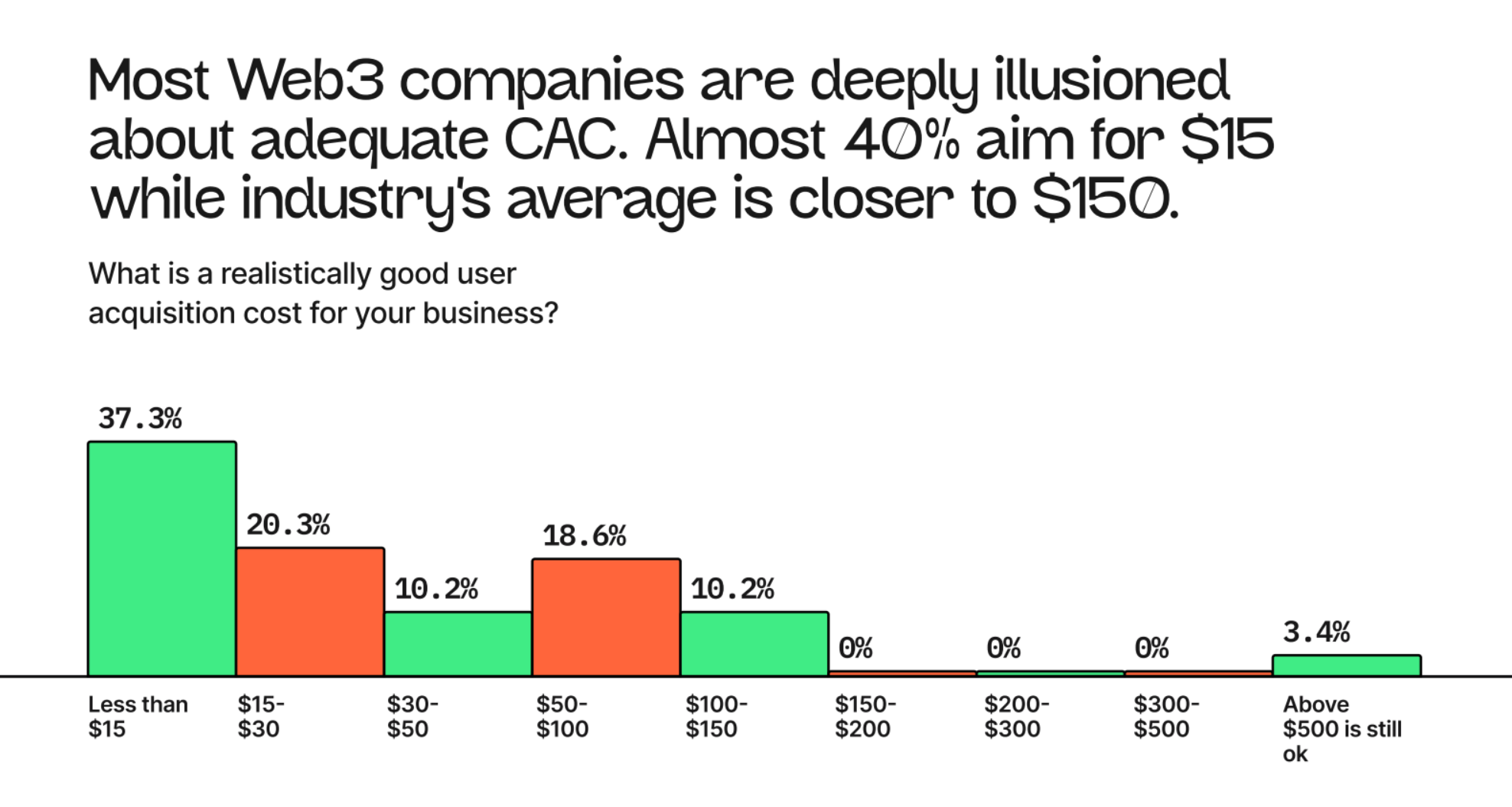
Those numbers are difficult to reconcile with the cost of acquiring users in adjacent high-trust categories.
Recent B2B SaaS benchmark data puts average CAC around $702, though the number varies heavily by company stage, segment, and sales motion. Fintech benchmarks also vary, but recent data shows CPA can range from $50 to $150 for high-performing campaigns and can be higher in more complex categories such as lending, B2B payments, and wealthtech.
Web3 is not identical to fintech or SaaS. But the comparison is useful because crypto products often require high trust, user education, and repeated exposure before adoption.
By fintech standards, that was efficient. By the expectations of many Web3 teams in the survey, it would still look expensive.
That is the disconnect.
Many teams are benchmarking against the wrong market memory. They remember earlier crypto cycles, where speculative demand, airdrop farming, and token incentives made acquisition look almost free. Those conditions distorted what teams came to expect from marketing.
KOL marketing is now a default Web3 distribution layer
The study found that 84.4% of surveyed Web3 companies used paid KOL campaigns in 2025. That made influence marketing the most widely used channel in the sample, ahead of quests, PR, and paid ads.
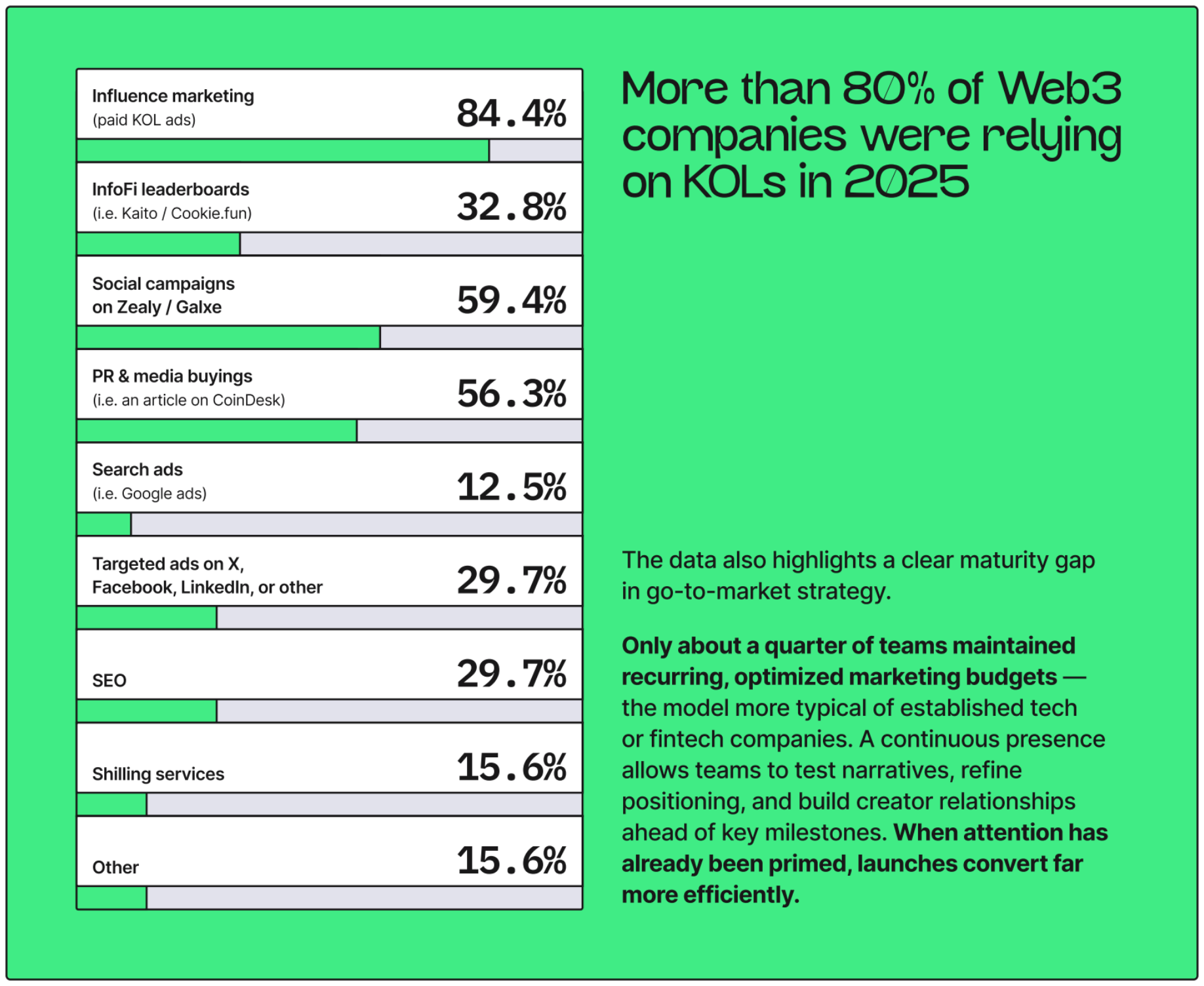
This does not mean every team should spend more on KOLs. It means KOL marketing has become a default distribution layer in Web3.
The more important question is how teams use it.
More than half of surveyed teams spent on marketing mainly around major events: a TGE, listing, launch, or product announcement. Only about a quarter had recurring monthly budgets.
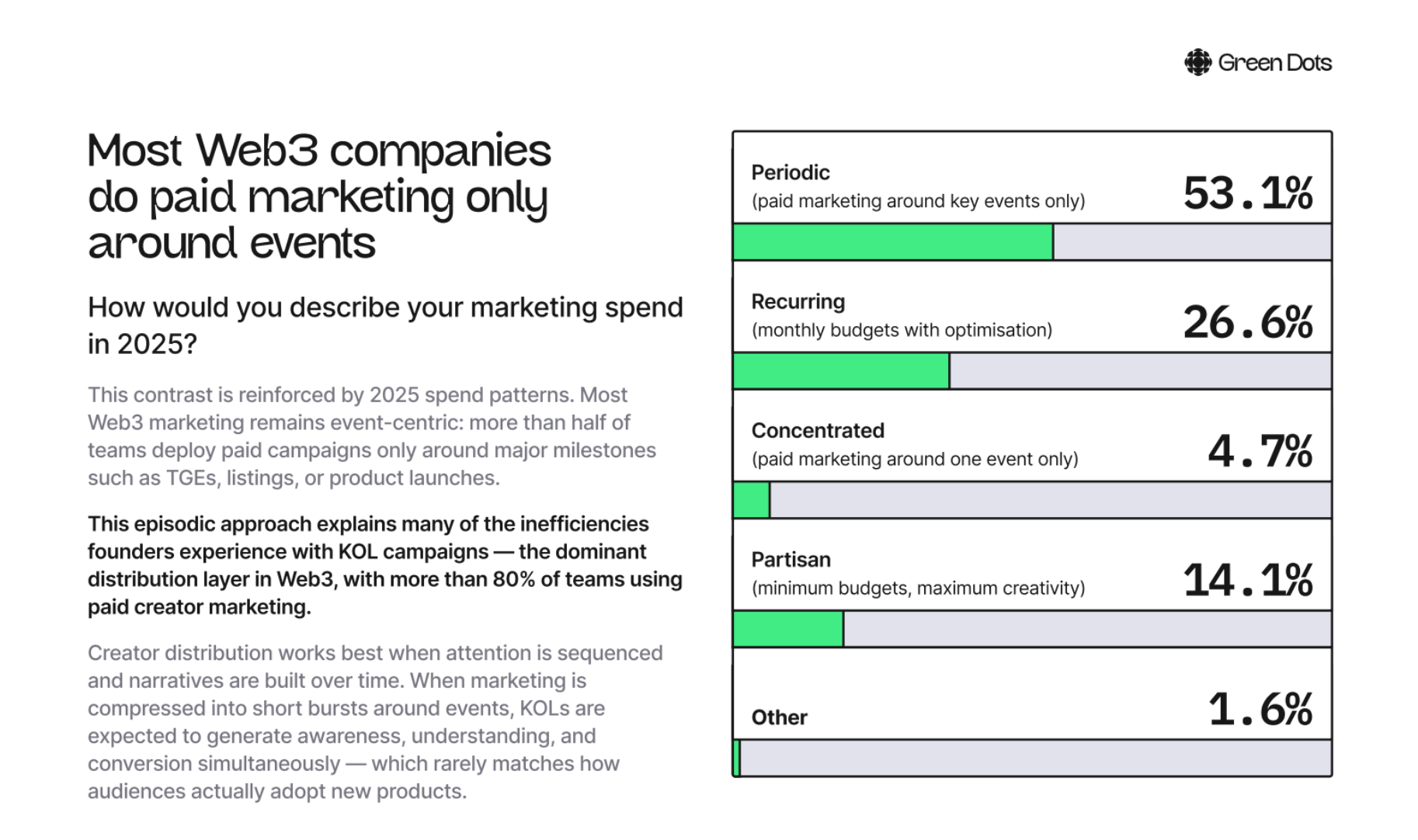
That campaign pattern creates a predictable problem. Teams ask creators to build awareness, explain the product, establish trust, and drive signups inside one short announcement window.
That is too much pressure for one campaign.
In our work with Web3 teams, creator campaigns perform better when the audience has already seen the product narrative before the activation moment. If the market has no prior context, KOLs have to educate and convert at the same time. That usually weakens both jobs.
Reputation now matters more than follower count
The study showed a clear shift in how teams evaluate creators.
When asked how they choose KOLs, surveyed teams ranked reputation and research/content quality above follower count. Reputation was selected by 66% of respondents. Research and content quality was selected by 56.6%. Follower count ranked near the bottom at 7.6%.
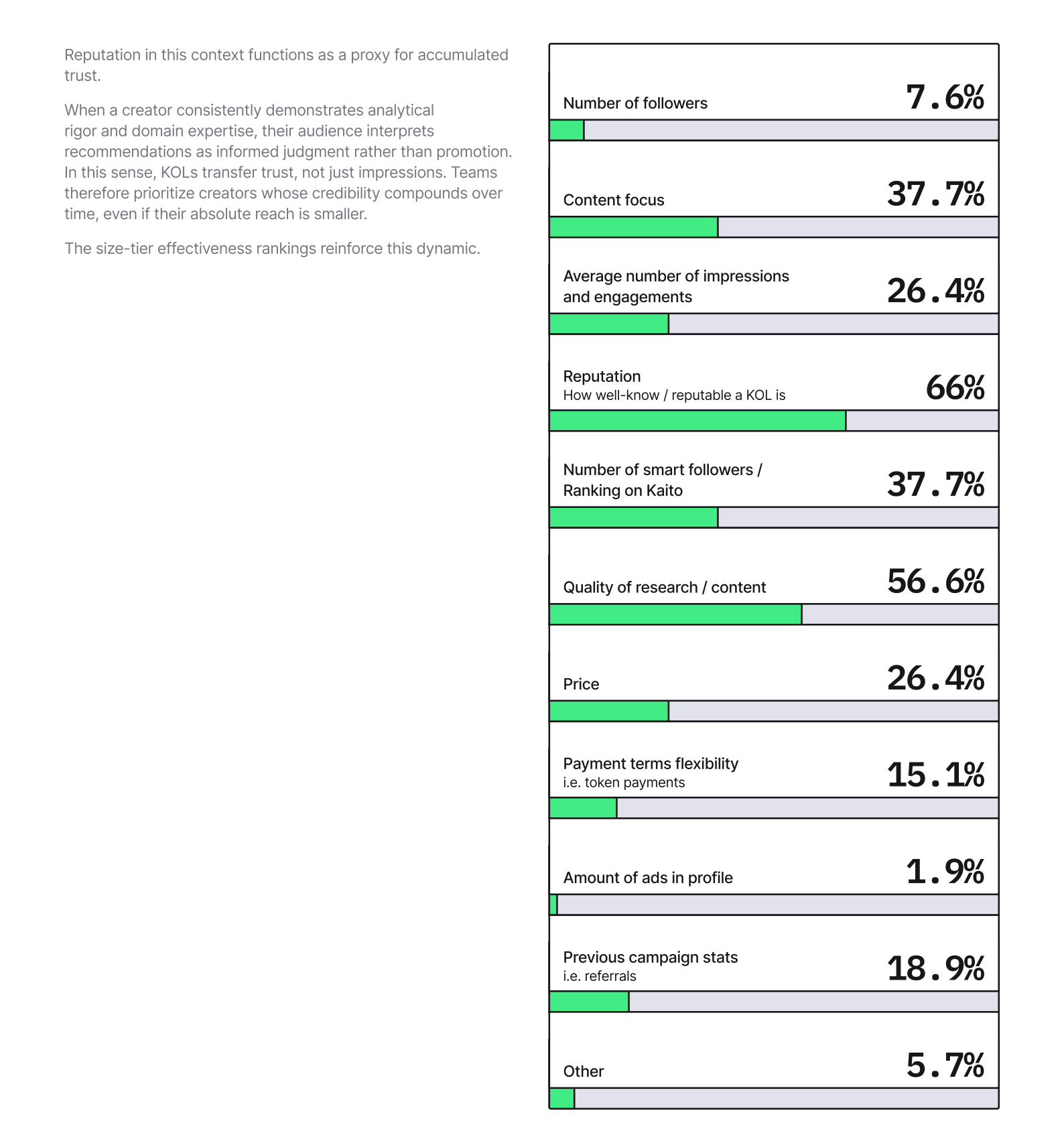
That matches what we see in campaign work.
Large accounts can create reach, but reach is not the same as audience fit. For complex crypto products, especially DeFi, infrastructure, trading, restaking, and on-chain products, the strongest creators are often not the largest accounts. They are the accounts whose audiences actually trade, farm, research, test, compare, and discuss products in the category.
Micro and mid-tier KOLs can outperform larger accounts when their trust is concentrated inside a specific user behavior.
The reason is simple: trust density matters.
A smaller creator with a relevant audience can move the right users. A larger creator with a broad, passive, or misaligned audience may only create temporary visibility.
Airdrop farmers distorted Web3 acquisition data in 2025
One-third of surveyed teams explicitly targeted airdrop farmers as a primary audience in 2025.
That matters because airdrop farmers behave differently from durable users.
They test products quickly. They compare reward-to-effort ratios. They move between campaigns. They can generate strong surface metrics: signups, wallets created, testnet activity, social tasks, community joins, and quest completions.
But those metrics do not always translate into retained usage.
This distorted how many teams judged campaign performance in 2025. A campaign could look strong on activity metrics while producing weak long-term adoption. That does not always mean the channel failed. It may mean the team acquired the wrong user type or rewarded the wrong behavior.
For Web3 user acquisition, the real question is not only “How much did the user cost?”
The better question is: Was the user real, relevant, and likely to retain once incentives declined?
A quarter of teams did not track acquisition costs
The study found that 25% of surveyed Web3 companies did not track marketing or user acquisition costs in 2025.
That is one of the most important findings in the report.
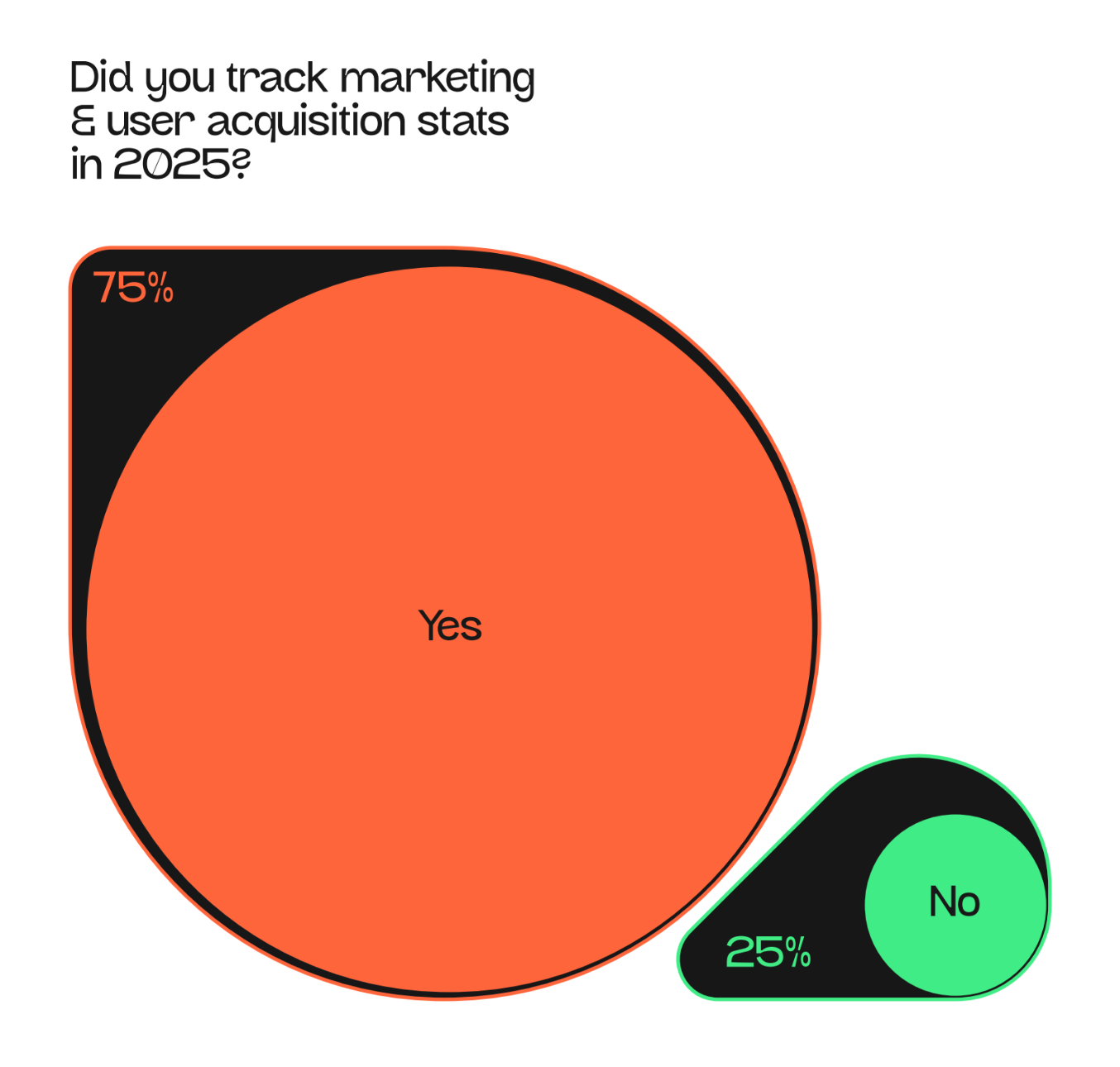
If a team does not track acquisition costs, it cannot clearly evaluate budget efficiency, compare channels, or understand whether creator spend is producing useful users. It ends up relying on impressions, follower growth, Discord activity, Telegram joins, or founder sentiment.
Those signals can be useful, but they are incomplete.
Crypto attribution is messy. Users move between wallets. On-chain actions do not always connect cleanly to off-chain touchpoints. CEX behavior can be invisible. KOL influence may show up weeks after the original post.
Still, teams can track directionally.
A practical Web3 CAC model can include:
- campaign spend by channel
- KOL spend by creator tier
- referral link data
- wallet cohorts
- quest or onboarding data
- on-chain activation
- community joins
- retention after incentives decline
- user quality by geography or segment
The goal is not perfect attribution. The goal is better decision-making.
Teams that track directionally usually build more realistic expectations. They can see which channels produce attention, which channels produce activation, and which channels produce users worth keeping.
Web3 marketing is moving from campaigns to partnerships
The strongest 2026 shift in the study is how teams plan to work with KOLs.
Ambassadorships and monthly retainers now rank above one-time paid deals in planned 2026 KOL strategy. Referral deals are also being layered into longer-term creator relationships rather than used only as isolated performance incentives.
This points to a broader shift in Web3 marketing.
Teams are moving from campaign-based media buying toward sustained narrative presence.
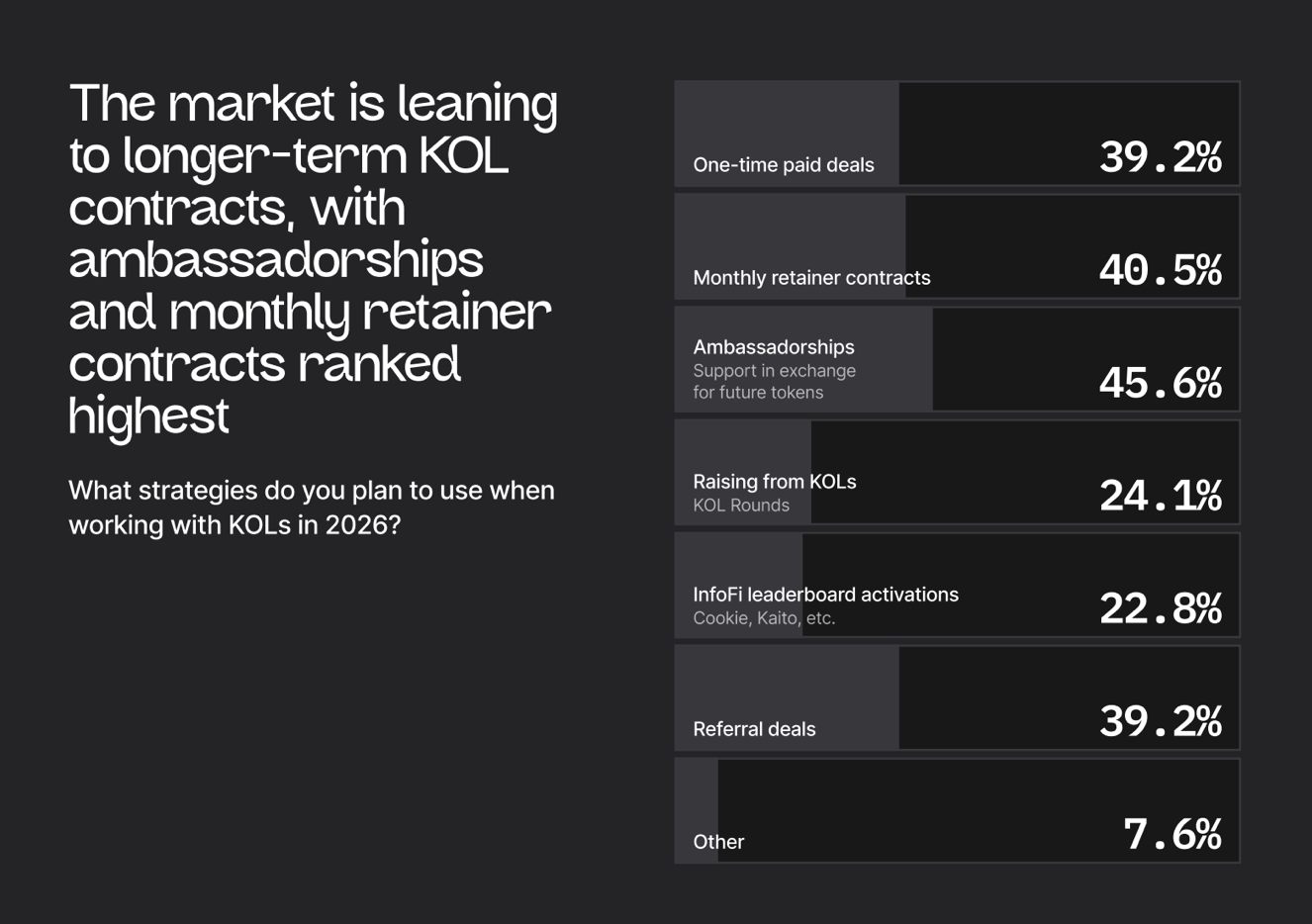
One-off campaigns can create visibility around a launch or announcement. But Web3 adoption usually needs repeated trust. Users need to see the product explained, questioned, compared, tested, and referenced by credible people over time.
That is why long-term creator partnerships can be more useful than isolated bursts. They give creators time to understand the product, build conviction, follow updates, and explain the project in a way that feels less transactional.
Founder personal branding is becoming part of acquisition strategy
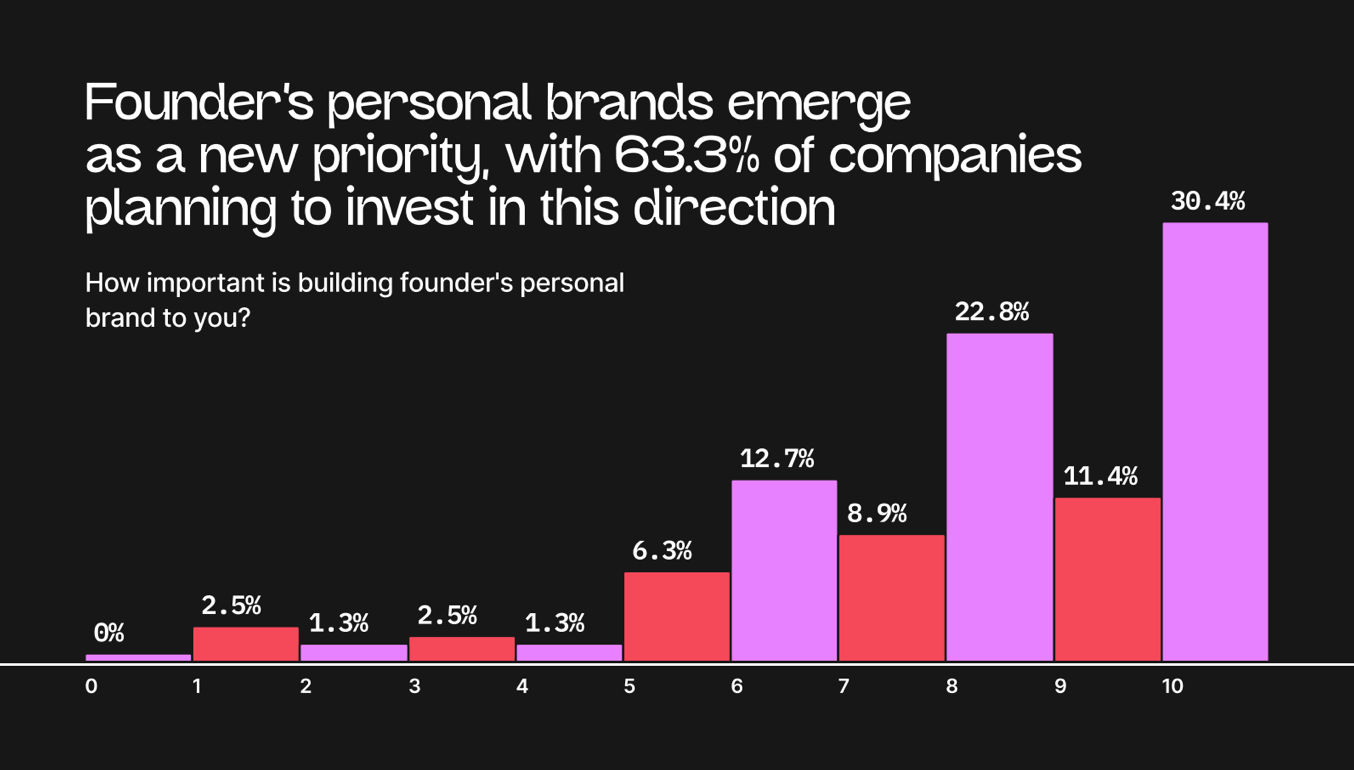
The study found that 63.3% of surveyed teams plan to invest in founder personal branding in 2026.
This is less about founders becoming influencers. It is about founders becoming a primary source of trust.
In crypto, people often trust people before they trust products. A founder who consistently explains product decisions, market views, tradeoffs, and what the team is building gives the market a clearer signal.
That signal supports the rest of the marketing stack.
Founders create the original narrative. KOLs translate and distribute it to different audiences. Communities discuss and repeat it. Search and AI systems can later index and summarize the owned version if the thinking exists outside social posts.
Without founder signal, teams often rely too heavily on external creators to create legitimacy for them. That can work for awareness, but it is more expensive and less durable than having the founder’s own public thinking reinforce the product.
AEO, GEO, and AI search are entering Web3 marketing
The study found that 44.3% of surveyed teams plan to explore AEO and GEO in 2026.
AEO, or answer engine optimization, is the work of making content easier for answer engines to find and summarize.
GEO, or generative engine optimization, is the work of making content easier for AI systems to understand, cite, and reuse in generated answers.
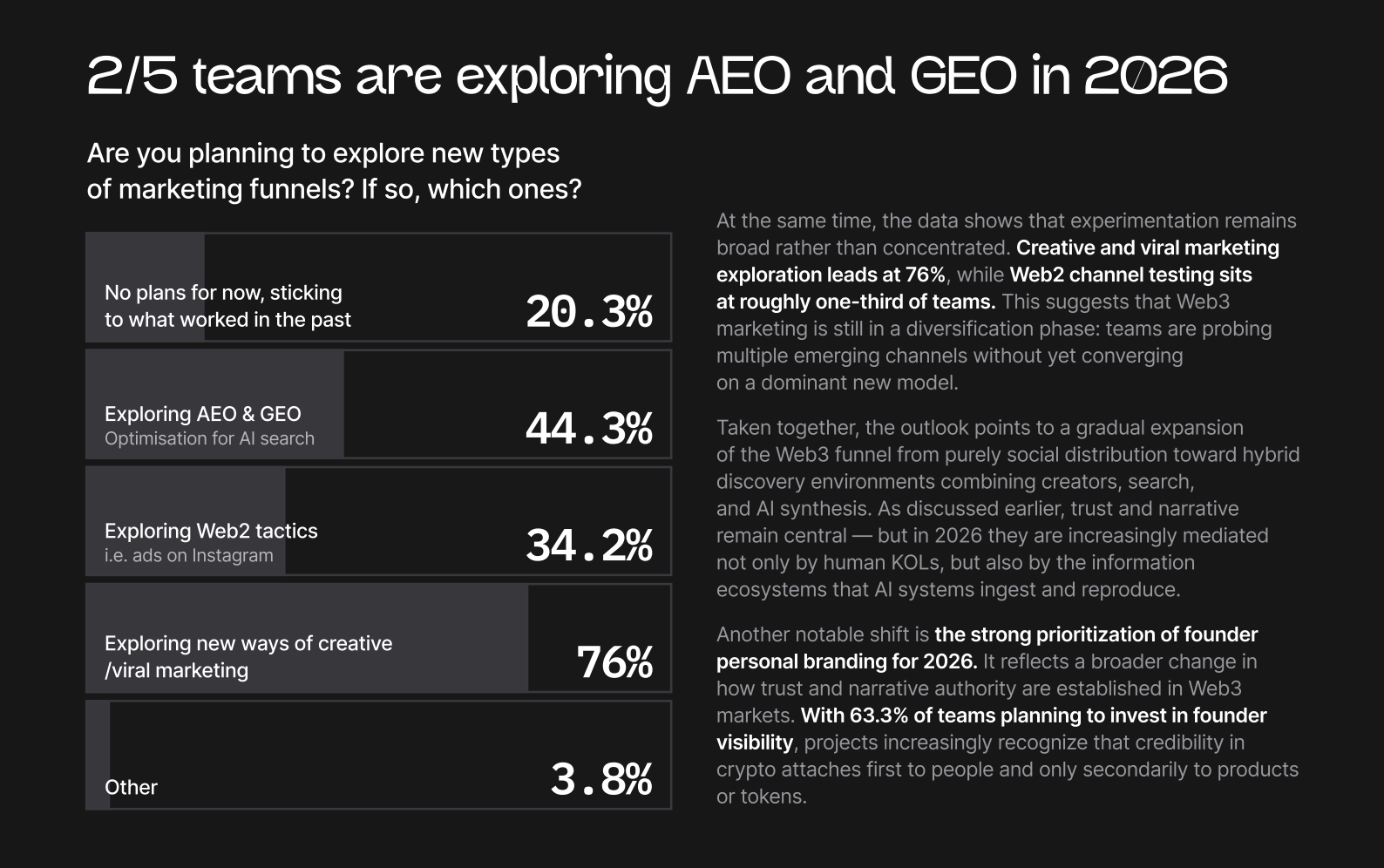
For Web3 teams, this matters because discovery is expanding beyond X, Telegram, Discord, and Google results pages. People increasingly ask AI systems to compare products, explain categories, summarize protocols, and identify credible teams.
That creates a new distribution problem.
If a project’s best thinking only exists in scattered X posts, Telegram messages, podcast clips, or temporary campaign content, AI systems may struggle to understand it. Teams need owned media, research pages, documentation, structured explainers, and durable narratives that can be indexed, referenced, and revisited.
This is especially important for products that require trust and education before adoption.
What Web3 teams should change in 2026
The study points to a practical shift in how Web3 teams should think about acquisition.
First, CAC expectations need to become more realistic. If a team is targeting users below $15 or $30, it should be clear about what kind of user that number represents and whether those users retain.
Second, KOL marketing should be treated as distribution infrastructure, not only announcement amplification. Creators work best when they have a clear audience, a clear narrative, enough context, and enough time.
Third, creator selection should prioritize reputation, audience fit, and research quality before follower count.
Fourth, teams need directional measurement. Perfect attribution may be impossible, but no attribution is a choice to operate blindly.
Fifth, founder signal is becoming part of the GTM system. A visible founder can create primary trust that creators, communities, and owned media can distribute.
Finally, Web3 teams need to prepare for AI-mediated discovery. Search visibility will not only come from ranking pages. It will also come from being understandable to systems that summarize and recommend information.
The main takeaway
The core shift is from cheap attention to durable adoption.
Web3 teams are not abandoning KOL marketing. They are learning that one-off visibility is not enough. Creator campaigns need better audience fit, stronger narrative clarity, longer relationships, and more realistic acquisition expectations.
The teams that adjust fastest will not necessarily be the teams with the largest budgets. They will be the teams that understand what kind of users they want, what those users need to believe before adopting, and how trust moves through creators, founders, communities, search, and AI systems.
For the full data, charts, and case studies, read the complete Green Dots 2025–2026 Web3 Marketing Study.
Subscribe to get new Green Dots Research field notes when they go live.
Author note
Written by Stacy Muur, founder of Green Dots.
Green Dots works with Web3 teams on GTM strategy, creator-led distribution, founder growth, and launch architecture.