
Web3 Retention: The Real Metric of Product-Market Fit
Web3 retention is one of the clearest signals of product-market fit. This article uses DeFi protocol data to show why users stay after incentives fade — and why acquisition spikes often hide weak product-market fit.

Most Web3 growth and adoption conversations still start with acquisition.
New wallets. New deposits. Campaign reach.
Those numbers are easy to show in a dashboard. They are harder to trust, though.
The better question is usually asked too late: Who stays after the incentive, the narrative, or the yield premium disappears?
In DeFi, retention has to be reconstructed through proxies: TVL trajectory, fee generation, revenue efficiency, yield competitiveness, chain deployment, liquidity depth, and user behavior during market stress.
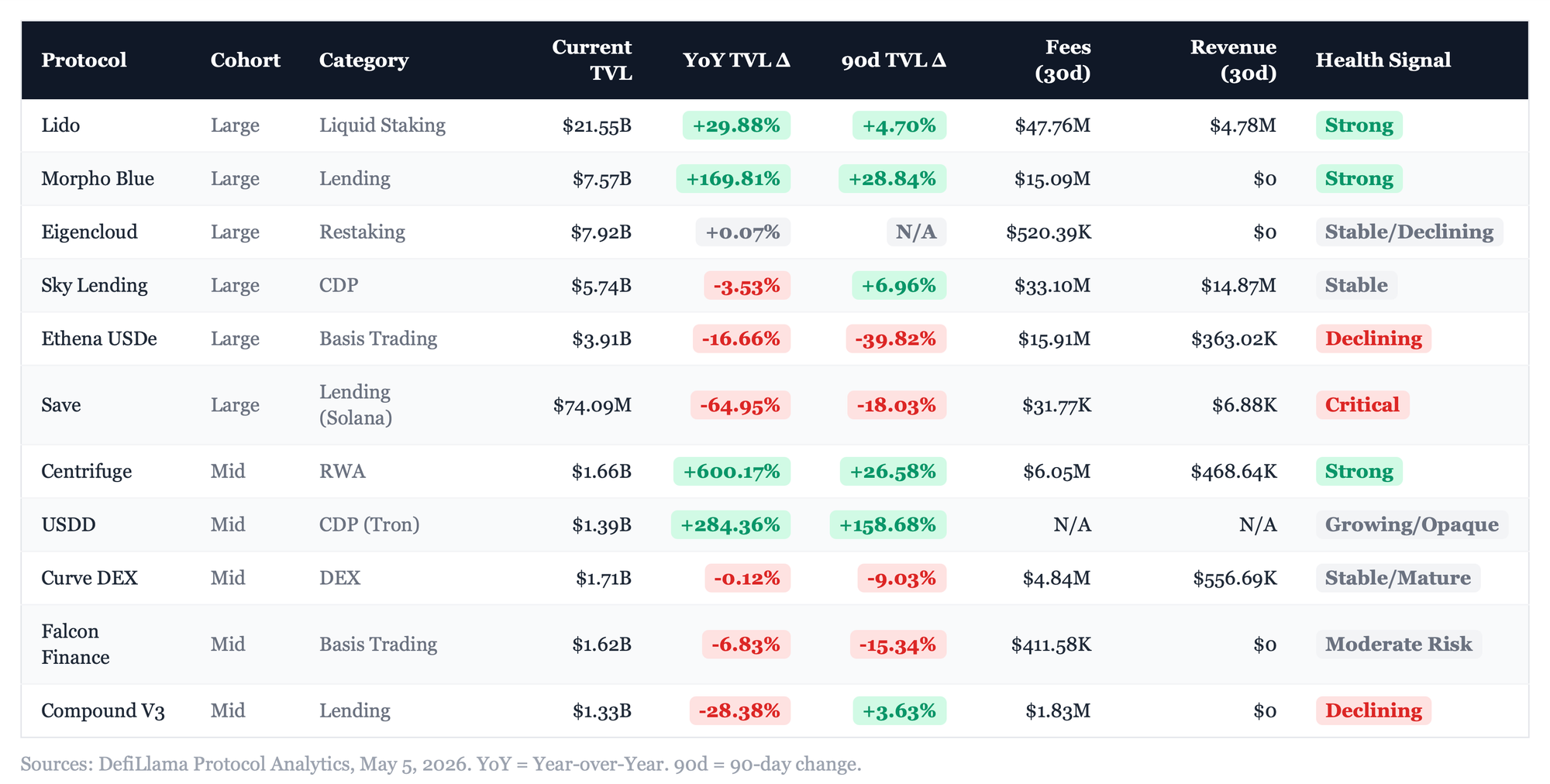
In our May 2026 internal research study, we analyzed 11 major DeFi protocols across these metrics to understand how user acquisition and retention actually work in Web3 markets.
The conclusion was direct: Web3 retention is not only a product metric. It is a trust metric, a yield metric, and a structural design metric.
The protocols with stronger structural retention mechanisms retained capital better and recovered faster after shocks. Protocols dependent on temporary incentives, speculative narratives, or unstable yield premiums showed weaker retention profiles.
The report found a clear split between structurally retained protocols such as Lido, Morpho, Centrifuge, and Sky, and more fragile profiles such as Ethena, Eigencloud, Save, and Compound V3.
What is Web3 retention?
Web3 retention is the ability of a protocol, product, or ecosystem to keep users, liquidity, capital, or activity after the initial acquisition trigger fades.
That trigger might be an airdrop, a high APY, a launch campaign, a KOL push, a points program, or a market narrative.
In DeFi, retention is often visible through capital behavior. If users keep liquidity in a protocol, continue generating fees, maintain collateral positions, or return after market stress, the protocol has a stronger retention signal.
This is different from basic acquisition.
Acquisition asks: How many users came in?
Retention asks: Why did they stay?
For Web3 teams, that second question is usually more important.
Airdrops can attract wallets. Yield can attract deposits. Incentive programs can create activity. Campaigns can create social traction. But none of those automatically create durable users.
In many cases, they create future churn.
Why Web3 user acquisition often hides weak retention
Web3 is extremely efficient at generating short-term movement.
A protocol can attract capital quickly if it offers enough yield. A campaign can generate transaction volume if the reward is clear. A token launch can create attention if the market believes there is upside. A points program can drive activity before users know whether the product matters.
This creates a measurement problem.
Teams often read acquisition spikes as growth. But some spikes are only borrowed attention or rented liquidity.
The DeFi retention study makes this visible.
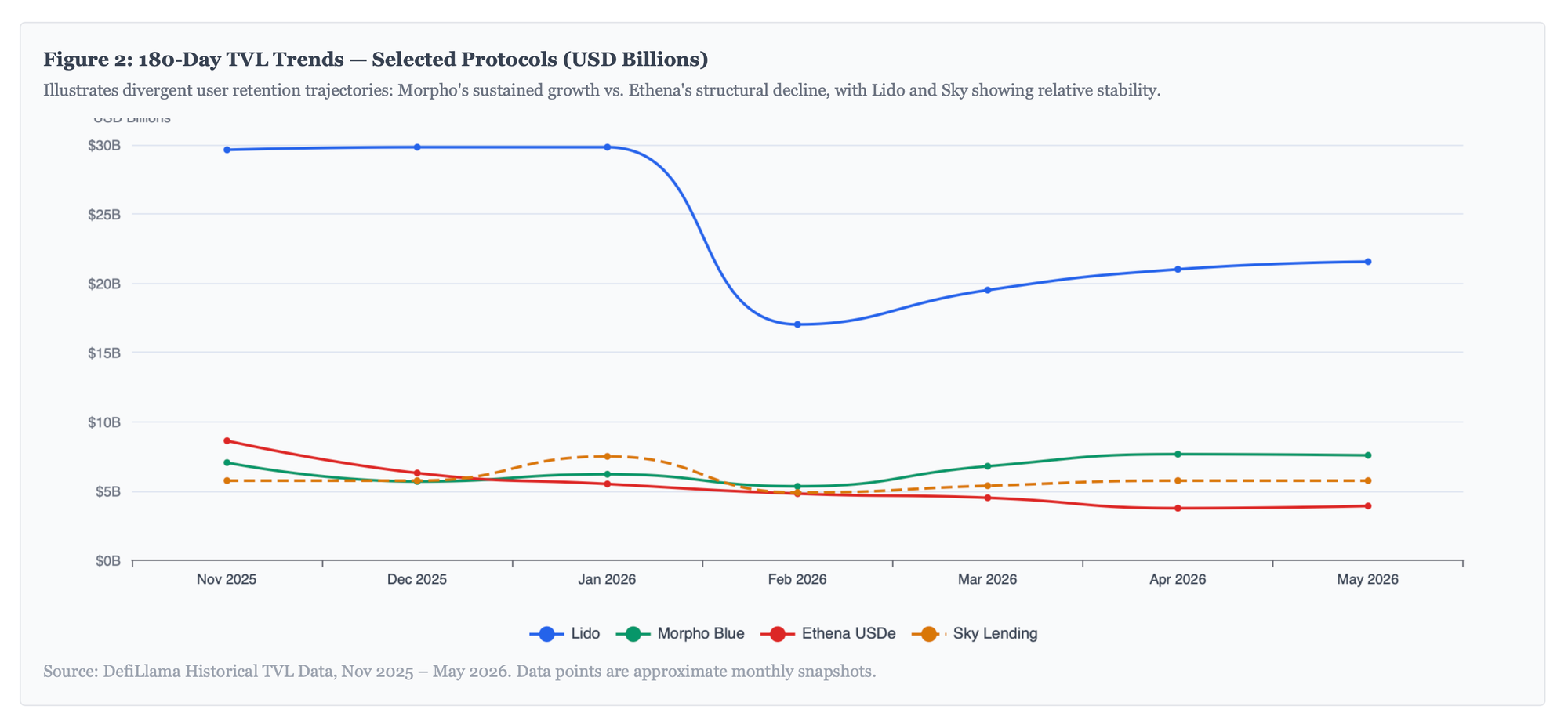
Ethena grew from $4.69B in TVL in May 2025 to $14.83B in September 2025, before falling to $3.91B by May 2026. That was an approximate 74% drawdown from peak. The problem was not acquisition. Acquisition was exceptional. The problem was retention quality.
During the mid-2025 bull market, Ethena’s funding-rate-driven yield model allowed the protocol to offer much stronger yields than many competing stablecoin products. Capital moved in fast. But once funding rates compressed and the yield advantage weakened, much of that capital left.
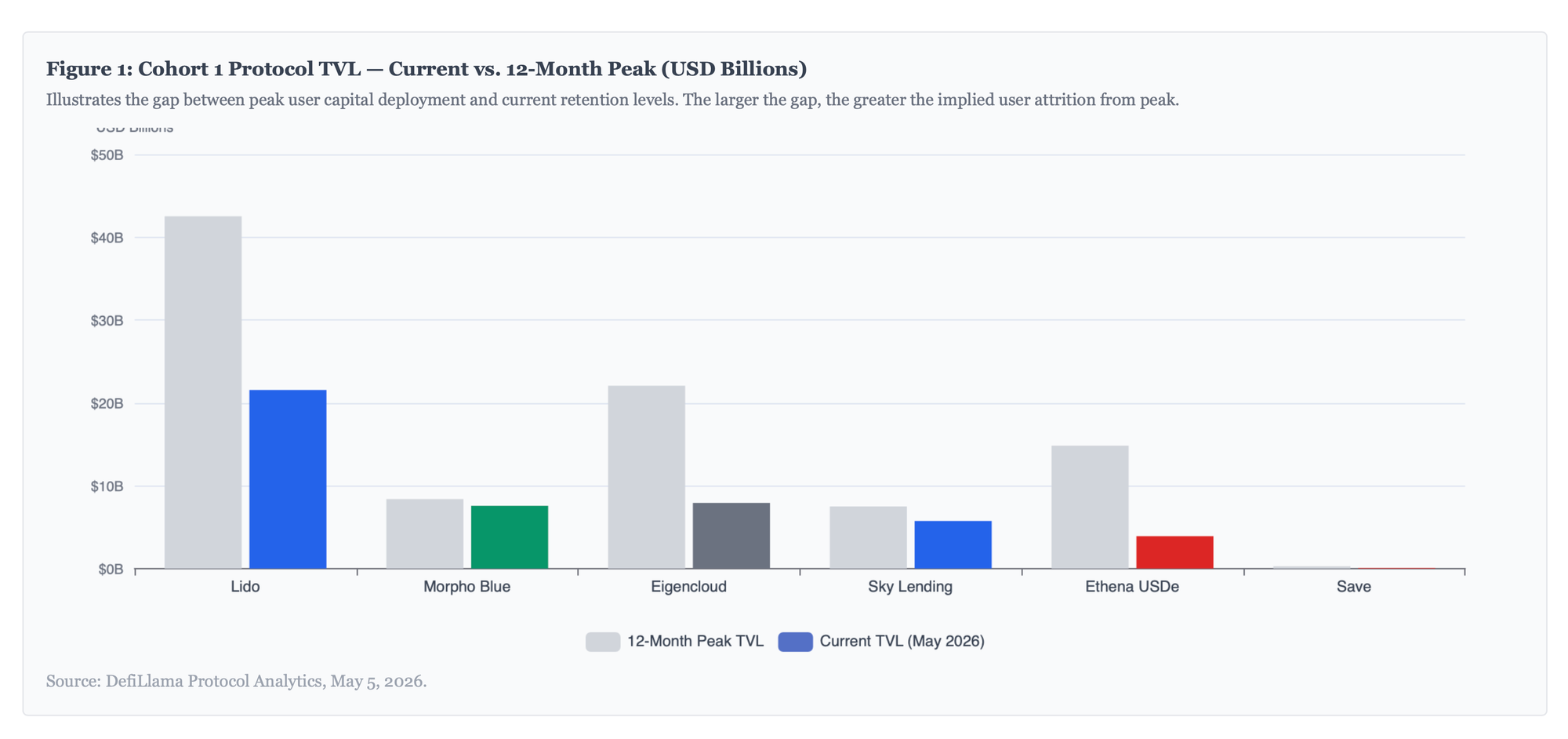
Eigencloud showed a similar pattern through a different mechanism. The protocol reached a peak TVL of $22.06B during the restaking and airdrop speculation cycle, then declined to $7.92B. Our research estimated an implied peak-to-current retention rate of around 36%.
The lesson is simple: Incentives can create acquisition. Structure creates retention.
How to measure retention in DeFi
There is no perfect DeFi retention metric.
Wallet-level cohort analysis is useful, but it is often difficult to standardize across protocols. Wallet behavior can be pseudonymous, fragmented across chains, distorted by bots, and shaped by large institutional positions.
Because of this, the internal study used a proxy-based framework.
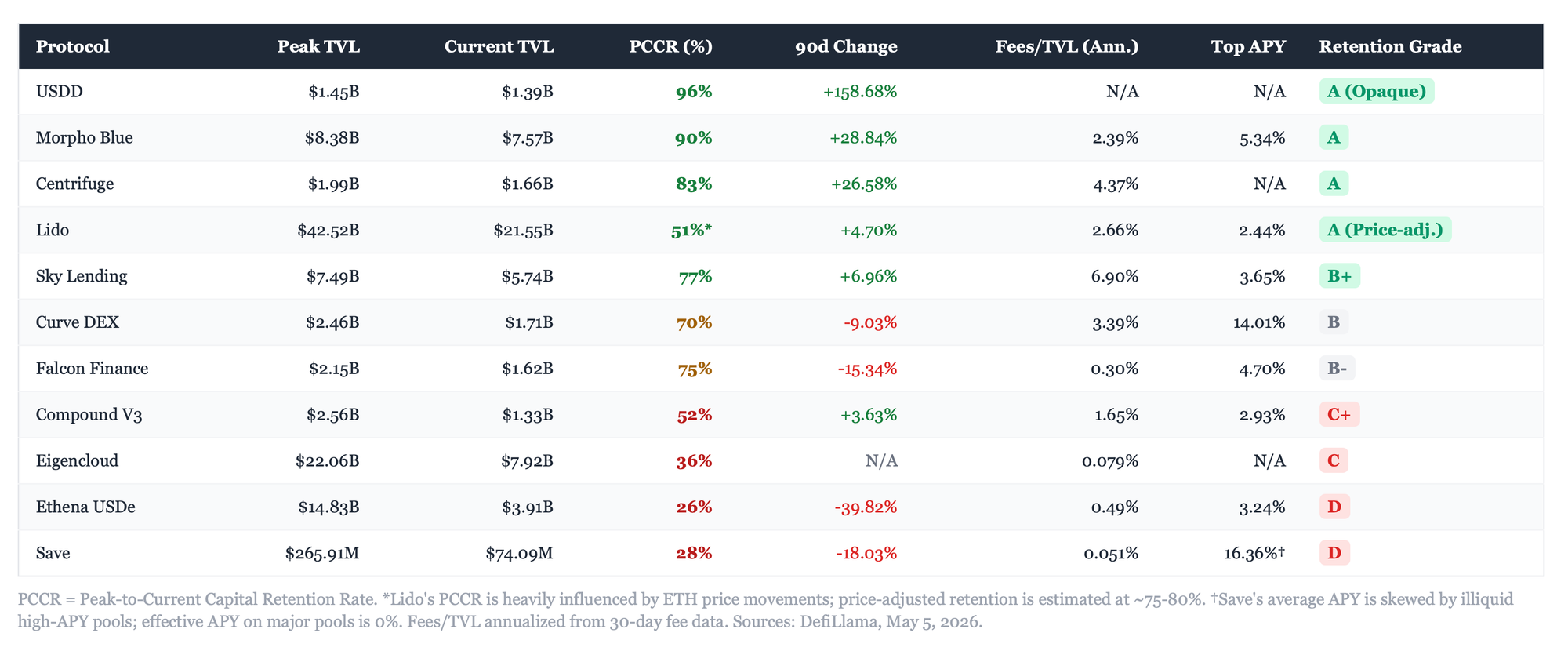
The key retention indicators were:
- Peak-to-current capital retention: how much TVL remains compared with the protocol’s 12-month peak.
- 90-day TVL change: whether capital is growing, stabilizing, or leaving in the short term.
- Fees-to-TVL ratio: whether locked capital is actively used or sitting passively.
- Revenue efficiency: whether the protocol can monetize retained users.
- Yield competitiveness: whether current APY is strong enough to keep yield-sensitive users.
- Stress-event recovery: whether users return after market shocks or security events.
This type of measurement is imperfect, but it is more useful than looking at acquisition alone.
A protocol with fast TVL growth and poor retention may be less healthy than a slower-growing protocol with sticky capital, active users, and strong recovery after drawdowns.
The strongest retention comes from switching costs
The strongest retention profiles in the study did not come from the loudest protocols.
They came from protocols where leaving created friction, opportunity cost, or operational complexity.
Lido is the clearest example.
stETH is not just a staking receipt. It functions as infrastructure across DeFi. Users can integrate it into lending markets, collateral strategies, liquidity positions, and other yield routes. Exiting Lido often means unwinding multiple connected positions.
That creates structural retention.
Our internal report showed Lido with $21.55B in current TVL as of May 5, 2026, $47.76M in 30-day fees, and a strong retention profile after adjusting for ETH price movements.
Centrifuge showed a different type of retention.
Its RWA products often involve defined investment horizons and institutional capital allocation workflows. These structures naturally reduce short-term capital rotation. In the study, Centrifuge showed +600.17% year-over-year TVL growth and an estimated 83% peak-to-current capital retention rate.
Curve also showed how governance and liquidity design can become retention infrastructure. Its veCRV model creates long-term switching costs by rewarding locked governance participation with influence and boosted yield access.
The pattern is clear: The strongest retention in Web3 appears when a protocol becomes infrastructure, not only a place to chase yield.
Yield is a strong acquisition engine but a weak retention layer
Yield remains one of the strongest acquisition levers in DeFi. That does not make it a strong retention layer though.
Users who arrive primarily for yield often do not have deep attachment to the protocol itself. They are attached to the spread.
This is why yield-driven growth can look strong while the underlying user base remains fragile.
Ethena is the clearest example from the report. The protocol acquired capital rapidly when sUSDe yields were meaningfully stronger than competing stablecoin products. But by May 2026, sUSDe APY had normalized to 3.24%, comparable to Sky’s sUSDS at 3.65% and below Falcon Finance’s sUSDf at 4.70%. Once the premium disappeared, capital rotated elsewhere.
This does not mean yield is bad. It means yield needs support from other retention mechanisms.
Long-term DeFi retention tends to come from:
- integrations and composability
- collateral utility
- governance structures
- institutional workflows
- lock-up mechanics
- network effects
- operational trust
- embedded ecosystem positioning
Yield can bring users in. It rarely keeps them alone.
Green Dots Research documents what we see across Web3 GTM strategy, creator-led distribution, founder growth, user acquisition, and market adoption.
Subscribe to get new field notes when they go live.
Stress events reveal retention quality
Many protocols look healthy during favorable market conditions.
Yields are elevated. Narratives are strong. Incentives are active. Liquidity is abundant. Users are willing to take more risk.
Stress events show what is underneath.
We used the April 2026 KelpDAO / rsETH exploit as a market stress test. The exploit triggered an estimated $10–15B in DeFi-wide TVL outflows within 72 hours. It affected protocols beyond the direct exploit surface because users became more sensitive to bridge risk, collateral risk, and protocol exposure.
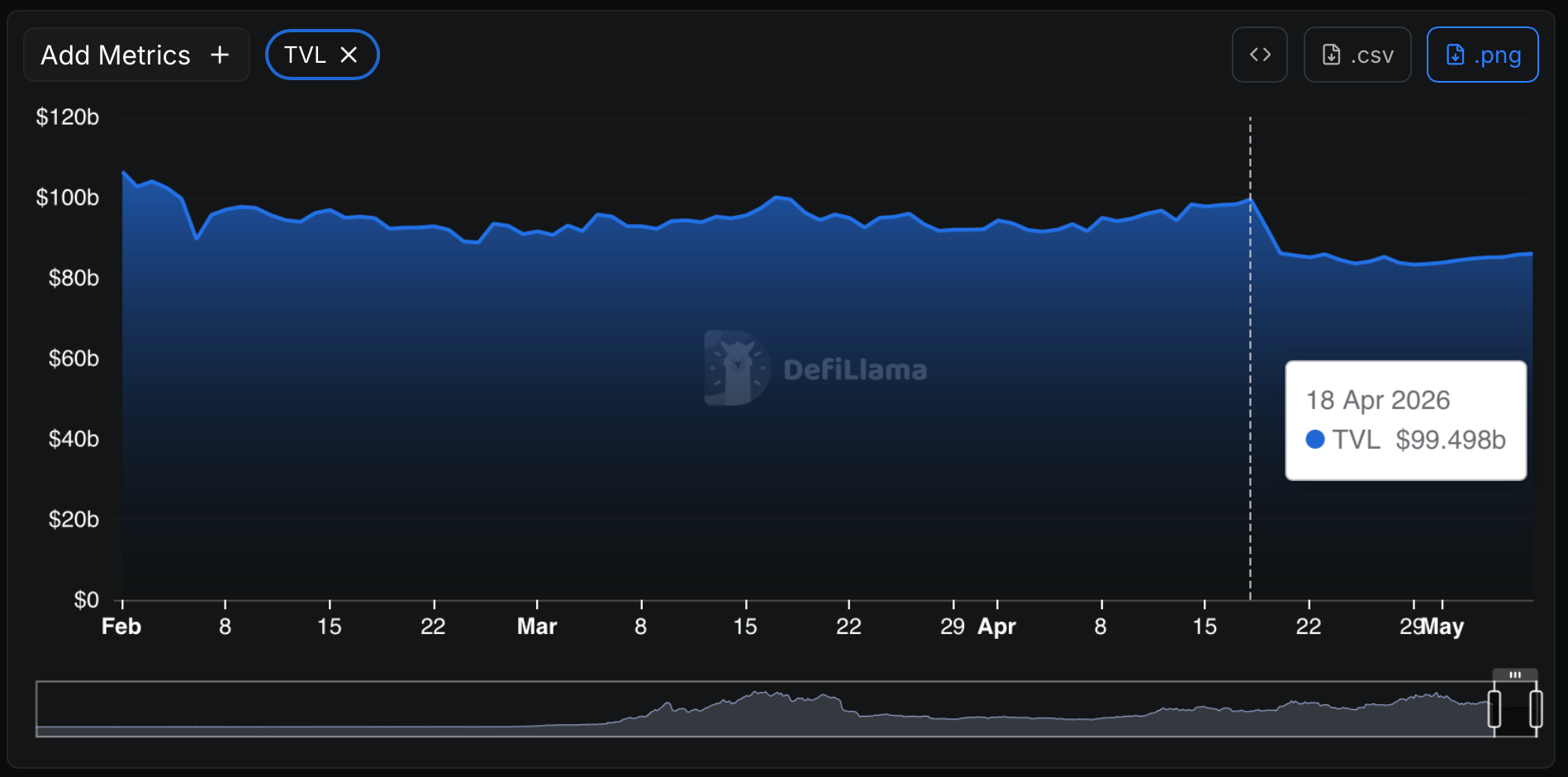
The useful signal was not only that capital left.
It was where capital returned.
Morpho experienced roughly $716M in outflows during the event but recovered close to peak levels relatively quickly. Sky also stabilized after a smaller drawdown. Protocols with stronger structural retention mechanisms and more institutional user bases showed higher resilience.
Meanwhile, protocols already showing weak retention profiles saw the shock accelerate existing outflows.
This matters for Web3 growth strategy because stress reveals user quality.
During negative market conditions, the questions become sharper:
- Are users conviction-driven or opportunistic?
- Do they understand the protocol’s risk model?
- Is the protocol integrated into their workflow?
- Is the product difficult to replace?
- Does the protocol have institutional trust?
- Does the user have a reason to return?
Retention quality often becomes visible only when the market gets worse.
Three common Web3 churn patterns
The report identified three major churn patterns across DeFi protocols.
1. Yield-driven migration
Users withdraw capital and move toward higher-yielding alternatives.
This was the clearest pattern in Ethena. Capital entered during a period of strong yield advantage and left as the premium compressed.
For teams, this is the most important lesson: if users came only for yield, they may leave as soon as another protocol offers better economics.
2. Security-driven panic withdrawal
Users leave after exploits, bridge vulnerabilities, contagion fears, or unclear exposure.
The KelpDAO / rsETH exploit showed how even protocols without direct exposure can face outflows when users reassess system-wide risk.
Security churn cannot be solved with a stronger campaign. It requires trust repair, clearer risk communication, and credible operational response.
3. Structural disengagement
Users gradually reduce activity because the protocol becomes less competitive over time.
Compound V3 and Save showed this pattern in the report. Both had weaker fee generation and declining competitiveness compared with newer alternatives. Save’s TVL declined 64.95% year-over-year, while Compound V3 declined 28.38%.
This kind of churn is slower and often more dangerous because teams can mistake it for a temporary market dip.
It usually requires product reinvention, not another acquisition push.
Why this changes Web3 GTM strategy
A lot of Web3 GTM strategy still treats acquisition and retention as separate problems.
That is usually wrong.
The best acquisition channels are the ones that bring users who are structurally likely to stay.
This changes how teams should evaluate growth campaigns.
The question is not only: How many users did we acquire?
It should also be: Why did they come, and what reason do they have to remain?
That applies to almost every Web3 growth channel.
Airdrops are not inherently bad. Points systems are not inherently bad. Short-time KOL campaigns are not inherently bad. High APY strategies are not inherently bad.
They become dangerous when they attract users whose only reason to participate is the temporary external reward.
In that case, the campaign does not build a user base. It builds a future churn event.
What better Web3 retention strategy looks like
Retention strategy should start before acquisition.
Before a team launches a campaign, it should know what type of user it wants to attract and what mechanism will make that user stay.
For a DeFi protocol, that mechanism may be collateral utility, yield stability, integrations, security credibility, governance participation, institutional workflows, or liquidity depth.
For a consumer crypto product, it may be habit formation, social graph, wallet utility, community participation, creator distribution, or identity.
For an ecosystem, it may be developer tooling, grants, liquidity access, network effects, founder relationships, and distribution support.
The principle is the same: Do not acquire users before understanding what will retain them.
In our work with Web3 teams, this is where many campaigns break.
The team can define the activation mechanic, but not the retention logic. They know what will make users click, deposit, mint, claim, or join. They are less clear on what makes those users come back.
That is not only a product issue. It is a GTM issue.
A stronger Web3 growth strategy connects:
- the audience being acquired
- the reason they enter
- the narrative they believe
- the product behavior expected after entry
- the retention mechanism that keeps them active
- the metric that proves durable value
Without that link, user acquisition becomes expensive motion.
The next phase of Web3 growth is acquired retention
The next phase of Web3 growth will not be won only by the protocols that generate the largest launch spikes or the highest temporary APYs.
It will be won by teams that understand the relationship between acquisition and retention.
The best teams will ask:
- What kind of users are we acquiring?
- Why are they entering now?
- What happens when the incentive disappears?
- What would make them stay during a market drawdown?
- What would make them return after a stress event?
- What structural role does the product play in their workflow?
The DeFi retention study showed this consistently across protocol categories. Protocols with structural retention mechanisms retained capital better, recovered faster after shocks, and built more durable user bases. Protocols dependent on temporary incentives, speculative narratives, or unstable yield premiums showed weaker long-term retention outcomes.
In Web3, retention is one of the clearest signs that a protocol has become useful enough, trusted enough, or embedded enough to survive after the campaign ends.
Acquisition gets users through the door.
Retention shows whether the product deserved them.
Subscribe to get new Green Dots Research field notes when they go live.
Author note
Written by Stacy Muur, founder of Green Dots.
Green Dots works with Web3 teams on GTM strategy, creator-led distribution, founder growth, and launch architecture. Green Dots Research documents what we see across GTM strategy, Web3 marketing, user acquisition, creator distribution, and market behavior.